
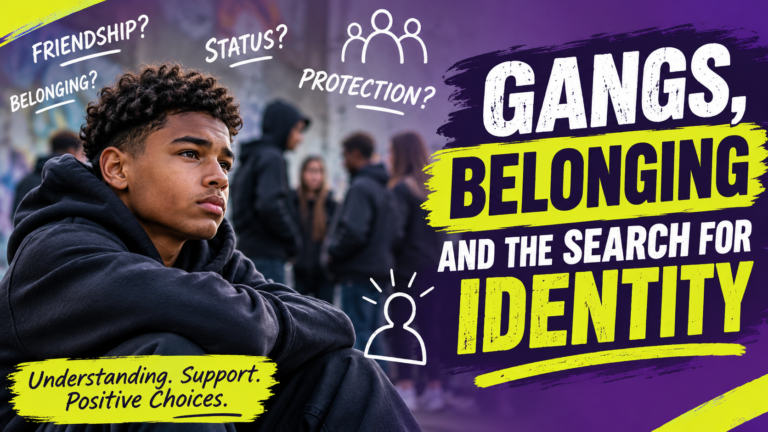
Before we talk about gangs, talk about belonging
Every child wants to feel that they matter. They want friendship, identity, recognition and a place where they are accepted. For many young people, these needs are met through family, school, sport, friendships and positive community spaces. For others, belonging may feel harder to find.
This is one reason discussions about gangs need to go beyond stereotypes. We cannot understand the appeal of a harmful group without understanding what it appears to offer. Sometimes that is friendship or status. Sometimes it is protection. Sometimes it is a response to exclusion, fear or a lack of positive opportunities.
Not every group of friends is a gang
Young people spend time in groups, adopt shared styles and develop strong loyalties. Those things alone do not make a gang. Professionals should avoid labelling children based on appearance, neighbourhood, ethnicity, music preferences or friendship circles.
Where there is concern about group violence, coercion or criminal exploitation, the response should be based on specific behaviours, reliable information and safeguarding assessment. Labels can damage trust and may obscure the different roles, pressures and vulnerabilities within a group.
How influence can turn into control
Some harmful groups use attention, money, status or protection to draw young people in. Expectations may gradually increase. A young person might be asked to prove loyalty, take risks, carry items, intimidate others or participate in violence. Refusal may bring threats or fear of rejection.
Digital spaces can intensify these dynamics. Messages, images, rumours and conflicts can travel quickly, making it harder for young people to step away from disputes. But technology is not the whole story: offline relationships, local environments and experiences at home or school remain important.
Understanding does not mean excusing
Children and young people are responsible for the harm they cause in ways appropriate to their age, circumstances and the law. Victims deserve recognition, protection and support. At the same time, we should ask whether a young person is being manipulated, threatened or exploited by others.
These two perspectives are not contradictory. A young person can need safeguarding support while also needing to repair harm and face appropriate consequences. Good practice makes space for both rather than reducing a complex situation to “bad child” or “helpless victim”.
Protective factors can be built
Positive relationships with trusted adults, a sense of belonging at school, opportunities to develop skills, safe activities and support for emotional regulation can all strengthen a young person’s options. The most useful intervention is often one that addresses the reason a harmful group feels attractive.
Families need information and practical support rather than automatic blame. Schools need clear safeguarding pathways and a culture where young people can disclose concerns. Community organisations need opportunities to work alongside education and statutory services rather than only being called after a serious incident.
The role of education and professional learning
On The Verge’s Gangs & Peer Influence work encourages children and young people to think critically about pressure, identity, choices and consequences. Our Beyond the Gang practitioner learning explores vulnerability, recruitment, coercion, group violence, contextual safeguarding and coordinated responses.
The question we want adults to ask is not simply “How do we stop this young person joining a gang?” It is also “What meaningful alternatives, relationships and opportunities are we helping them build?” Prevention becomes stronger when young people have something positive to belong to.
Find out more
Explore On The Verge gang-awareness education and Beyond the Gang practitioner learning. Visit www.ontheverge.uk to find out more or contact the team.
On The Verge UK CIC | BELIEVE • LEARN • GROW